
INSIGHT
When AI can act: Why authorization must be engineered
NOVENTRIX |
Giving AI access to business systems changes more than the way work gets done. It changes how organizations must manage permissions, accountability and operational risk.
An organization considering an AI agent for its IT operations may begin with a relatively straightforward objective: reduce the time engineers spend investigating recurring incidents. The proposed system could examine monitoring alerts, retrieve relevant documentation, correlate events and recommend corrective action. If it performs reliably, the next question will almost certainly be whether it can carry out some of those actions automatically.
That is where the nature of the decision changes. Allowing a system to identify a possible configuration problem is different from permitting it to modify the configuration. The first depends primarily on the quality of information and recommendations. The second introduces questions about access privileges, change authority, service availability and accountability if the action produces an unexpected result.
These considerations are not unique to artificial intelligence. Technology leaders have dealt with them for years through access management, change control, application security and operational governance. What changes with agentic AI is the flexibility with which software can interpret an objective, select a course of action and interact with several systems to complete a task.
The immediate challenge is therefore not simply whether an AI agent is capable of performing an operation. It is whether the organization has established the authority under which that operation may take place.
The difference between capability and authority
AI agents are generally designed to pursue objectives through a sequence of activities. Depending on their configuration, they may retrieve information, use software tools, call application programming interfaces (APIs) and decide which step to attempt next. Some operate largely as assistants, while others can execute defined tasks with limited human intervention.
The distinction from a conventional AI assistant is not absolute. Both may use similar language models, and an assistant can also be given tools. From a business and security perspective, the more important distinction is the level of access and execution authority assigned to the system.
Consider an agent investigating a production application incident. It may examine recent changes, compare system metrics and conclude that restarting a service could restore normal operation. The recommendation may be reasonable, but it does not establish that the agent should be allowed to restart that service. The affected application might support critical transactions, depend on other systems or be subject to an approved maintenance procedure.
If the agent has been given administrative credentials, the connected platform may accept its request. Technically valid credentials, however, do not necessarily mean that a particular action is appropriate for the circumstances.
This distinction becomes especially important when an agent works with information from different sources. Monitoring alerts, support tickets, emails, retrieved documents and external websites can all influence its interpretation of a task. Some of that information may be incomplete, outdated or deliberately manipulated. A malicious instruction embedded in a document could, for example, attempt to persuade the agent to access information or invoke tools outside the legitimate task.
Security controls must account for that possibility. Instructions within the model's operating context can guide behavior, but they should not be treated as a substitute for permissions and business rules enforced by the systems processing its requests.
An AI agent may propose an action based on its available information. The authority to execute that action must be established independently.
A finance workflow illustrates the difference
Consider a business that receives a growing volume of supplier invoices and wants to reduce the manual work involved in processing them.
An AI agent could read incoming invoices, extract the required information, compare it against purchase orders and identify discrepancies. Employees could review the results and decide which invoices should proceed. This is a useful application with a relatively contained operational scope.
The next stage might allow the agent to create draft entries in the accounting system or submit invoices into an established approval workflow. These activities require write access, but the organization can still restrict which records the agent may create or modify and which actions require further review.
The risk profile changes substantially if the same agent is permitted to amend supplier bank details, approve invoices and initiate payments. Each function may be legitimate in isolation, but combining them under one broadly privileged identity could weaken the separation of responsibilities that the finance department relies upon to prevent errors and fraud.
A responsible design would not depend on the agent deciding for itself whether these controls are necessary. The accounting and payment systems should independently validate the operation against the relevant permissions, transaction limits, supplier records and approval requirements.
For example, the agent might prepare a payment instruction for a verified invoice. Before execution, the payment workflow would confirm that the supplier and destination account are valid, the amount falls within approved limits and the necessary authorization has been obtained. The approval would apply to that specific transaction, not to any subsequent instruction the agent might generate. If the amount, beneficiary or other material details changed, the authorization would need to be reassessed.
This approach does not prevent the organization from automating significant parts of invoice processing. It separates tasks that can be delegated safely from decisions and actions that remain subject to established financial controls.
The same reasoning applies outside finance. An IT agent may investigate an incident without being allowed to alter production infrastructure. A service agent may prepare a customer refund without having unrestricted authority to issue payments. A cybersecurity agent may recommend disabling a compromised account while the actual change remains governed by defined permissions and escalation rules.
The operating model should determine the agent's authority, rather than allowing the availability of a technical capability to determine the operating model.
Designing the authorization boundary
Once an agent can interact with business applications, authorization becomes an architecture requirement. It should not depend solely on an instruction telling the agent to behave responsibly or seek approval before undertaking sensitive work.
The system needs a defined boundary between the agent's proposed actions and their execution. At that boundary, an independent policy or authorization component evaluates whether the requested operation is permitted. The decision may depend on the identity of the initiating user, the agent's assigned role, the target system, the specific operation, the data involved and the applicable business restrictions.
An agent authorized to retrieve customer information should not automatically be permitted to alter customer records. Similarly, access to a deployment tool should not imply unrestricted permission to modify production environments. Permissions should reflect the legitimate purpose of the agent, with separate controls for operations carrying different levels of risk.
Human approval remains important, particularly where an action could affect financial records, customer data, service availability or security permissions. However, approval only provides meaningful assurance when the reviewer can see what is being authorized and the execution system can verify that the approved details have not changed.
A reviewer approving a payment should be presented with the beneficiary, amount and other relevant transaction details. The execution system should verify that the authorization remains valid for that exact operation. For sensitive or irreversible activities, controls may also need to prevent an approval from being reused or the same transaction from being executed twice.
Approval cannot override an independent policy restriction simply because an AI agent presents a convincing explanation. Nor should approval permit an agent to acquire privileges beyond those assigned to the business process. Final authorization checks and the connected application's own permissions remain necessary at execution.
The architecture below illustrates this separation.
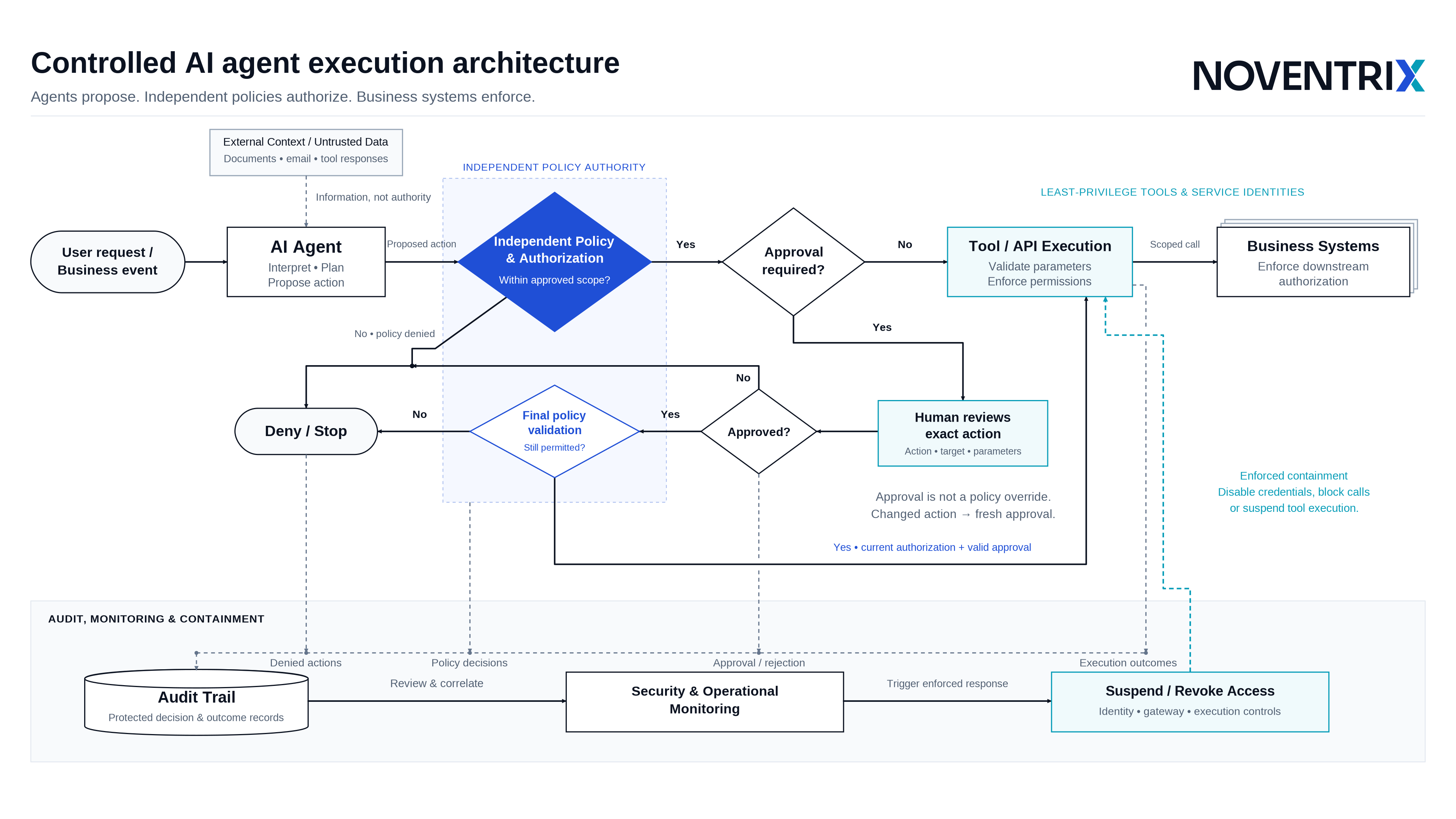
The diagram distinguishes the agent's reasoning and proposed actions from the independent decisions required before execution. Low-risk operations may proceed automatically within an approved scope, while sensitive activities are routed for human review. Actions that fail policy checks or required approvals are stopped. The execution layer and downstream business systems retain responsibility for validating requests and enforcing permissions.
The supporting audit and monitoring controls are equally important. An organization should be able to establish which request initiated an operation, what the agent proposed, which policy and approval decisions applied, and what the connected system actually executed. Records must be appropriately protected and should not disclose sensitive information unnecessarily.
Monitoring also needs a practical response mechanism. If an agent begins making unusual requests, repeatedly encounters authorization failures or behaves outside expected limits, operations personnel should be able to suspend its activity, disable relevant credentials or block further tool execution.
These are familiar disciplines from identity management, application security, DevSecOps and operational assurance. Their application to agentic AI is not fundamentally new, but the range of actions an agent may attempt makes consistent enforcement particularly important.
Human oversight and operational responsibility
Introducing a human approval step does not, by itself, make an autonomous workflow dependable. A reviewer may be presented with a technically plausible recommendation without sufficient information to judge its operational consequences. Frequent approval requests can also turn a control into a routine administrative exercise, particularly when employees are under pressure to resolve incidents or complete transactions quickly.
Effective oversight therefore depends on the quality of the information available to reviewers, the significance of the decision and the ability of the underlying systems to enforce its outcome.
A useful starting point is to determine which activities genuinely require human judgment. Requiring a person to approve every routine information retrieval may add unnecessary delay without materially reducing risk. Allowing an agent to make unrestricted administrative changes, on the other hand, may create exposure far beyond the efficiency gained.
Technology and business owners need to agree on these boundaries before granting production access. The process owner should define what the system is expected to accomplish and which decisions may be delegated. Technology teams should establish the technical permissions and integration controls. Security and risk functions should evaluate relevant threats and control requirements, while operational teams retain responsibility for monitoring, exceptions and recovery.
In a smaller business, these responsibilities may be held by a limited number of people or supported by an external service provider. That does not remove the need to establish who has authority to approve the automation, who can change its permissions and who is responsible when it fails.
The organization should also test more than whether the agent completes a successful demonstration. Testing needs to cover unexpected inputs, unauthorized requests, duplicate operations, unavailable applications and attempts to influence the agent through untrusted content. Where actions can have significant consequences, the team must understand whether they can be reversed and how normal operations will be restored.
Changes after deployment deserve similar attention. Updating the model, introducing a new tool, expanding data access or modifying a workflow can change what the agent is able to do. Those changes should be reviewed and tested in proportion to their potential impact, rather than treated as ordinary adjustments to a chatbot.
Deciding how much autonomy the business can support
There is no requirement for every useful AI implementation to become fully autonomous. In many organizations, the best initial result may come from improving the quality and speed of recommendations while retaining human control over execution. In others, carefully bounded automation of routine tasks may deliver measurable benefits without introducing unacceptable risk.
The decision should reflect the nature of the work. A repetitive task with predictable inputs, limited permissions and readily reversible outcomes is a different candidate for automation from a process involving significant financial exposure, sensitive information or production system changes.
Leaders should also account for the operating effort required to support the proposed level of autonomy. Integration, identity management, testing, audit collection, monitoring, exception handling and recovery all have costs. A demonstration that completes a workflow successfully does not establish that the organization is ready to operate it reliably over time.
Before expanding an agent's authority, management should be able to establish what operational improvement is expected, which systems and records the agent will access, the maximum consequence of an incorrect action, and how that action will be detected, contained or reversed. The answers should inform both the technical design and the approval to proceed.
A controlled implementation can then increase its scope as the organization gains evidence of reliability, operational benefit and effective control performance. Greater autonomy should be a deliberate decision supported by experience and assurance, not the automatic next stage of an AI project.
Agentic AI offers opportunities to remove repetitive work and improve the responsiveness of business operations. Realizing those benefits requires more than selecting a capable model or connecting it to available software tools. It requires the same discipline applied to other systems that are trusted to act on behalf of the organization.
The responsibility for deciding what may be automated, what must remain subject to approval and how failures will be managed ultimately rests with the business and its technology leadership.
The practical objective is not to give AI as much authority as possible. It is to delegate enough authority to deliver value while retaining effective control over the consequences.
References
- OWASP, AI Agent Security Cheat Sheet.
- OWASP, AI Agent and MCP Security.
- NIST, AI Risk Management Framework.